

In our most recent article, “Governance is a Design Problem: A Framework for Founders Building Companies that Last” we shared what founders and business leaders should know about values-led governance and enforcement. In this piece, we explore other mechanisms that go beyond that.
In the business world, values-led decisions are defined as choices guided primarily by values rather than by short-term financial return. But what determines whether a company can make values-led decisions in the first place?
The answer is a combination of factors such as ownership, governance, capital, stakeholder relationships, financial position, market conditions, and political environment, that shape what values-led decisions are available to a company at any given moment. The totality of these interconnected factors is what we call Freedom of Choice. Some of them sit within a leader's direct control, some are negotiated with stakeholders, and some can only be influenced over the long term. Leaders can even expand their future Freedom of Choice by adopting constraints that block misaligned decisions later, as Patagonia and Kickstarter did through trust ownership and charter amendments.
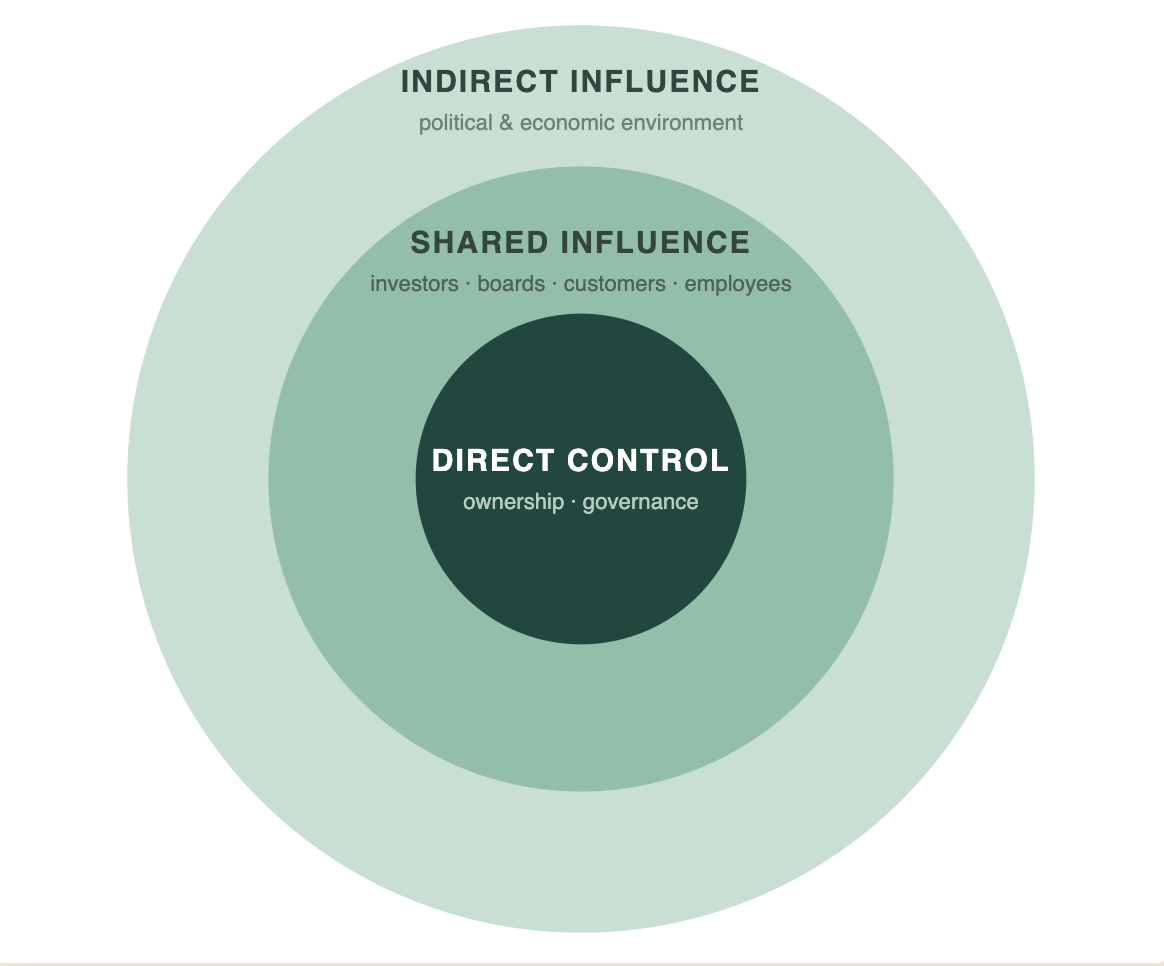
Companies put values into daily practice through a variety of procedural and structural mechanisms, which can be legal, cultural, operational, and external. Even though governance and ownership remain the foundational mechanisms, the companies whose values endure rarely rely on a single lever. They layer structural protections with cultural, market, and relational reinforcement. They prove their case with data, draw on stakeholders for pressure and foresight, share the cost of change through partnerships, and engage government and civil society to reach broader action. Where our previous article treated governance as a design problem, this one is a reminder that the design extends beyond the corporate charter.
Beyond ownership, governance, and culture
There are several ways to implement mechanisms that shape how values are operationalized and reinforced within a company. Below are some examples:
- Metrics help demonstrate fiduciary duty. When a company cannot set values-based goals through its legal structure, leadership must show that values-led decisions support long-term value. Measuring material outcomes such as retention, loyalty, resilience, risk and reduction, makes it easier to justify certain actions or strategies to boards and investors. For example, Walmart framed emissions reduction as supply-chain risk management, Starbucks tied tuition benefits to retention, and Microsoft positioned accessibility as risk mitigation and market opportunity.
- Engaging stakeholders offers pressure, foresight, and accountability. Employees, consumers, investors, and civil society can prompt or reinforce action and make commitments harder to reverse. For instance, unionized nurses advanced staffing standards that improved both patient outcomes and hospital finances. Other examples include a shareholder proposal that moved McDonald’s off polystyrene packaging, and sustained pressure shifted Apple on right-to-repair. Those stakeholders that are closest to a company’s operations often are able to identify risks earlier.
- Partnerships and collaboration reduce the cost of moving first. Formal partnerships, bound by contract and sometimes tied to specific outcomes, are among the more durable external mechanisms. This includes pre-competitive collaborations that let companies share the cost of raising standards before they compete. Because such arrangements can raise antitrust questions, the report advises seeking legal counsel before collaborating with competitors.
- Government engagement and advocacy connect company action to systemic change. Voluntary corporate action alone cannot reach the scale needed to address problems such as inequality or ecological degradation. Without shared rules, first movers absorb higher costs and others have little incentive to follow. Advocacy becomes more consequential when paired with investors, policymakers, and civil society to shift norms and, eventually, the rules that govern all companies.
The broader a leader's range of mechanisms, the better positioned their values are to survive growth, transition, and pressure.
Transform Finance is a research, education, and implementation partner supporting founders, investors, and advisors working toward a more transformative economy. Explore our Values-Led Business Learning Hub for more resources on alternative ownership structures and governance.


